Case description
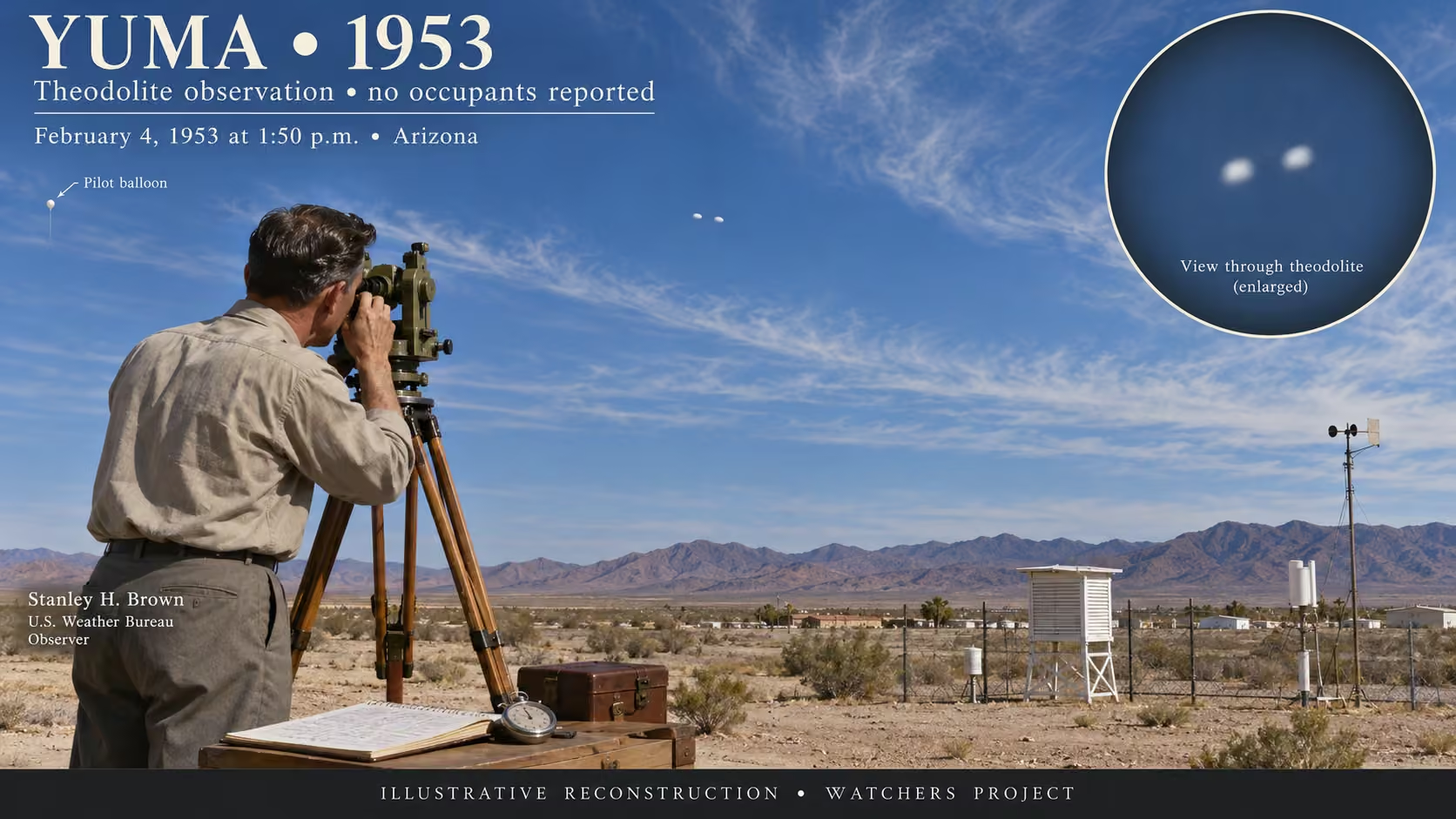
U.S. Weather Bureau observer Stanley H. Brown was tracking a pilot balloon above Yuma, Arizona, at 1:50 p.m. Mountain Standard Time on February 4, 1953. James McDonald’s 1968 congressional testimony reproduces information obtained from the station meteorologist, V. B. Gotten. The balloon was around 6,000 feet; that altitude should not automatically be assigned to the unidentified objects subsequently entering Brown’s theodolite field.
Brown described two small, dull-white, nearly round objects edged by a thin mist. The first curved upward; approximately twenty seconds later another entered, moved out of the field twice and rejoined it. Using the stopwatch already available for his weather work, Brown timed about five minutes of tracking before the pair disappeared against cirrus to the south-southwest. His original balloon observation was interrupted.
McDonald reported the official classification as unidentified and discussed why he considered airborne particles an inadequate explanation. That status does not establish extraterrestrial origin. No landing, close approach, occupants or humanoid encounter appears in the recovered account, despite this record’s imported close-encounter classification. The plate shows Brown and the tracking instrument with restrained white objects; the optical inset enlarges their appearance for legibility and supplies no invented craft structure.