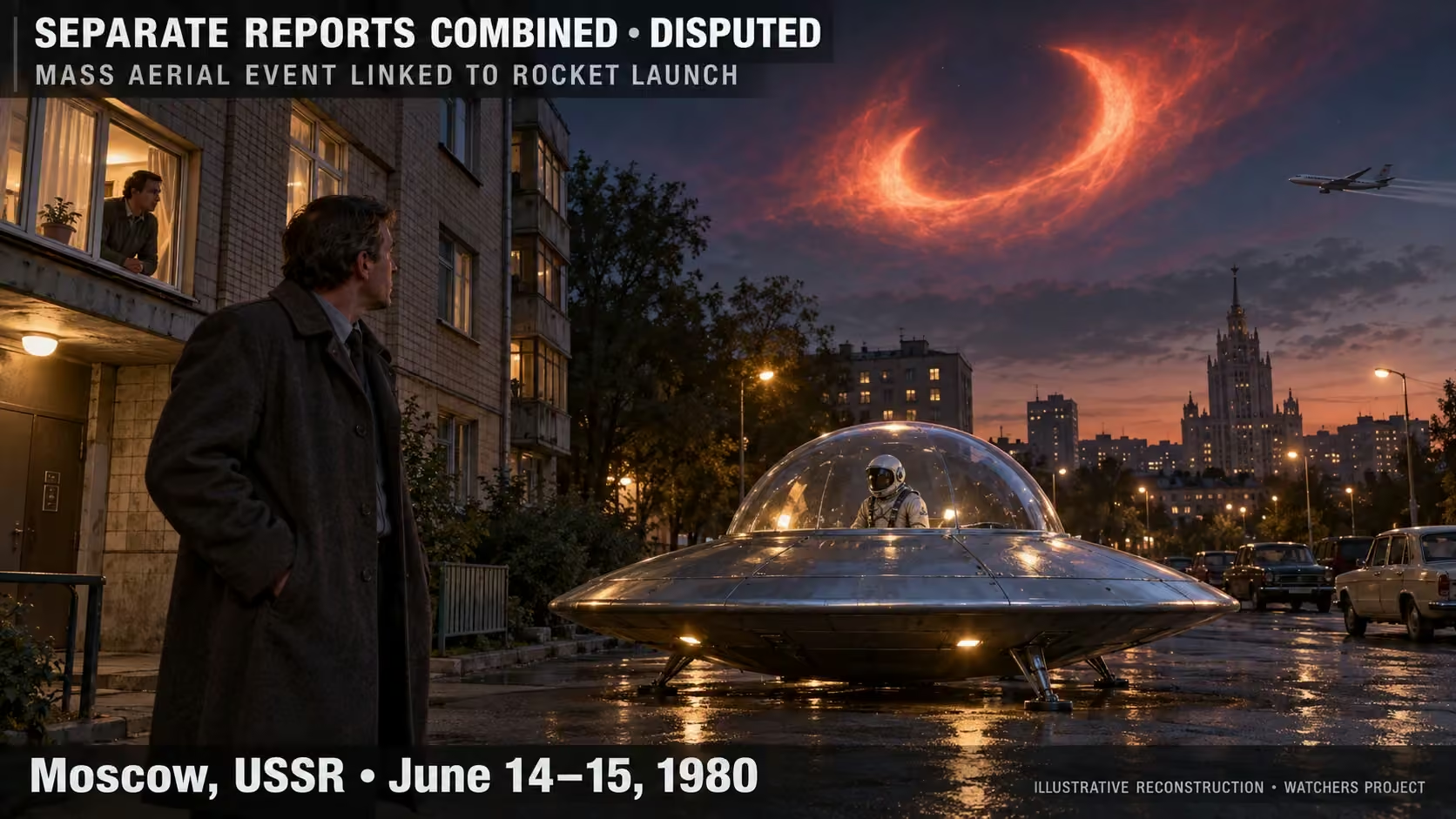
The Moscow entry compresses several claims surrounding the night of June 14–15, 1980. Around midnight, observers across a broad part of the Soviet Union reported an enormous reddish or orange aerial display, described in some accounts as a horseshoe or crescent surrounded by luminous gas. Later publicity added assertions about intercepting aircraft. The catalogue's thousand-foot saucer and aerial combat wording should not be mistaken for a verified combat report.
Separate landing stories entered the same source chain. Lieutenant-Colonel Oleg Karyakin reportedly saw a saucer outside his home, while a neighbour described a small human figure in a spacesuit beneath a transparent cupola. Another account attributed to television director Aleksandr Koreshkov concerned a noisy object in the street and a very small man nearby. These were separate testimonies, not occupants demonstrably observed inside the large aerial phenomenon.
James Oberg traced the mass display to the launch of Kosmos 1188 from Plesetsk at 20:55 UTC on June 14, corresponding to Moscow's late evening. Pekka Teerikorpi independently discussed a satellite-launch explanation in Flying Saucer Review. That identification addresses the widespread sky event; it does not authenticate the landing anecdotes. The plate is explicitly a composite of distinct reports, and the Atlas preserves the catalogue's disputed context without presenting every associated story as a proven hoax.
Covers the June 14, 1980 mass sky display and explains its correspondence with the Kosmos 1188 launch. This does not authenticate the separate landing anecdotes or the catalogue’s aerial-combat wording. The wider compilation contains other Soviet reports.