UFO case file · UFO-41591
JONQUIERES (11) 28.04.2013
JONQUIERES (11), Languedoc Roussillon, FR
Open this case in the interactive Atlas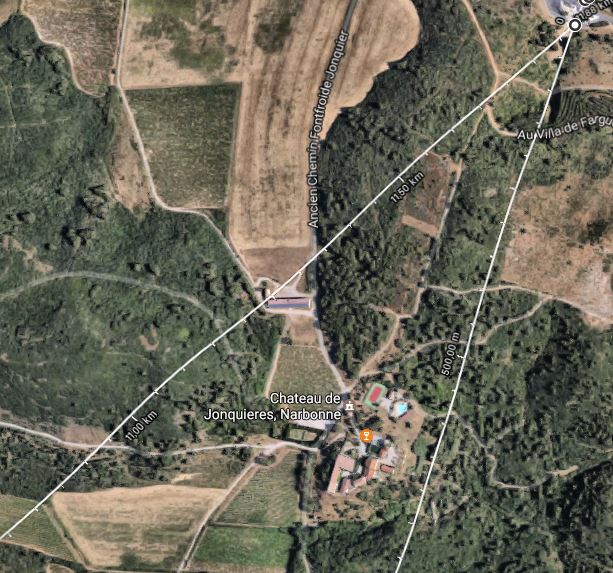
Case description
On 28 April 2013 at midnight, a woman driving a car observed the repeated winding movements of a whitish glow low in the sky. Her female passenger also saw it. Only 1 questionnaire was collected.
The observation had 3 stages:
1-a) Around midnight on Saturday night into Sunday, the passenger first saw a luminous phenomenon from the moving car on the motorway.
1-b) The driver stopped at the next rest area, 500–800 m beyond the first sighting. The 2 witnesses remained in the car and watched for 1 hour. The phenomenon was above the trees at an elevation the witness estimated as 30°.
1-c) Since it did not disappear, the witness resumed driving.
Météociel weather records for Béziers, about 50 km northeast, at 23:00 on 27 April and in the early hours of 28 April 2013 report 8/8 cloud cover, no precipitation (the last very light precipitation being at 14:00 the previous day), 60 km visibility and a westerly wind around 10 km/h with some gusts. The weather was identical at Carcassonne, 60 km west in the opposite direction.
There was a single luminous phenomenon, a pale whitish glow with no geometric shape. It moved at treetop level, repeatedly following the same winding path, “like a bird flying,” with no sound or trail. Its size was difficult to estimate because the witness could not judge its distance.
While stopped in stage 1-b, the witness described a short path passing alternately behind 2 trees about 20 m apart. At the initial motorway sighting, stage 1-a, she said, “We had the impression it was close by.” On departure, stage 1-c, the passenger said, “It's following us.” GEIPAN interprets the latter impression as indicating a considerable distance, since the bearing remained unchanged while the witness traveled at high speed.
The date was significant: Saturday night into Sunday, 27–28 April 2013, shortly before the extended break around Labour Day, 1 May, and during the Montpellier education district's Easter school holidays, 20 April–5 May 2013.
The setting was also distinctive. A few kilometers west of Narbonne, the motorway passes through undeveloped rolling limestone hills with Mediterranean scrub and pine woods, interspersed with vineyards (see map). There are also wine estates or “châteaux” with cellars; some offer guest accommodation in the countryside with swimming pools and tennis courts.
The witness suggested a beam projected onto the cloud base but questioned whether it could produce the observed appearance—the path's regularity and the glow's characteristics—and where it could originate, saying that “there are only pine woods there.”
All these factors favor the witness's suggestion of a light beam projected onto the cloud base.
Analysis of the photographs supplied by the witness locates the camera position at the Narbonne-Jonquières rest area, stage 1-b, using her statement and refining it with the silhouette of the pines against the sky. This provides an estimated photographic azimuth (Azimut_serre.jpg). Extending this viewing sector (Azimut_moyen.jpg) identifies the area from which the light display originated. It includes at least Château de Jonquières, 700 m from the witness. Other possibilities, events at Abbaye de Fonfroide and illumination of Château de Saint-Martin, were excluded because they lie outside the sector.
To check the hypothesis by triangulation, the investigators used the first-sighting position, 500–800 m before the rest area. Plotting that distance along the motorway shows that before that point the road climbs through a cutting, widened to 3 lanes, with slopes on both sides obscuring the horizon. At 800 m back, the road is on the plateau with a clear horizon ahead and a view of Château de Jonquières, 1.35 km away. The phenomenon at 45° to the car's right could hardly have gone unnoticed.
As a further check, the witness estimated an elevation of 30° from the rest area. At the proposed distance of 700 m, the height is 700 × tan(30°), approximately 400 m, consistent with the cloud-cover altitude.
These elements support a light display, very probably from Château de Jonquières or its outbuildings. At the time of the report, however, the owner could not be reached by telephone to confirm this.
The distances of 1.3 km in stage 1-a and 700 m in stage 1-b explain several reported features:
- Low brightness.
- The non-geometric shape and irregular trajectory, as a projection viewed side-on against the uneven base of moving clouds.
- The impressions that it was close and followed the witnesses, arising from the small change in the UAP's bearing despite the car's movement, itself due to the considerable distance.
GEIPAN consequently classifies the case A: a light display.
Recorded details
- Local time
- 00:00
- Coordinate precision
- Source-provided or normalized location; precision not increased beyond source.
- Date precision
- day