UFO case file · UFO-42188
GRAND-COURONNE (76) 17.04.2016
GRAND-COURONNE (76), Haute Normandie, FR
Open this case in the interactive Atlas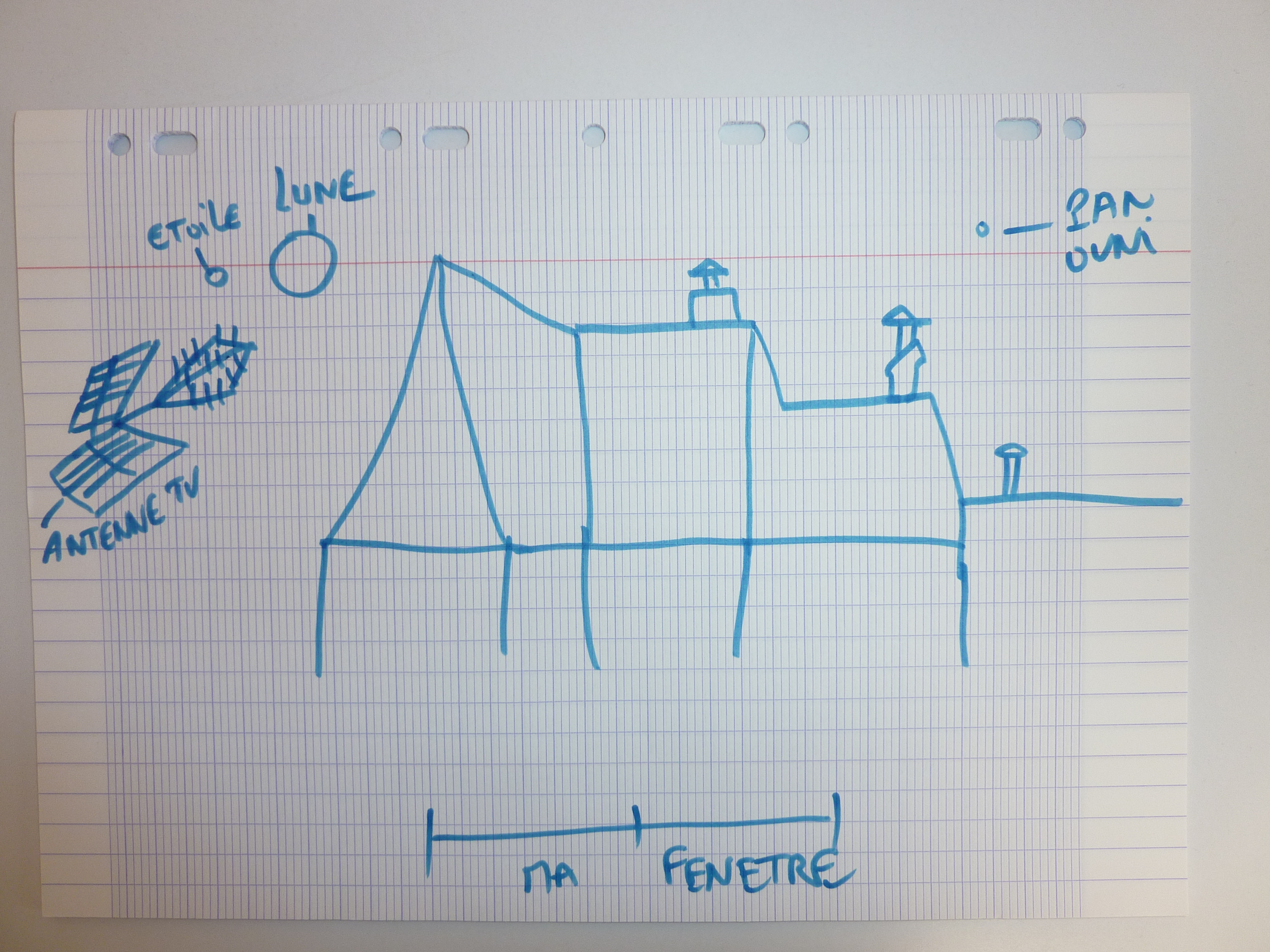
Case description
On Sunday, 17 April 2016 at about 21:12, a couple saw a puzzling bright round object in a clear sky, twinkling in several colors. The Moon was to its left, with another very bright “star” nearby. One witness recorded video, temporarily removed from the publication because of a technical problem. When they looked again at about 22:25, the object was gone. A colleague reportedly saw the same thing, but only 1 account was collected.
The case was well documented with a photograph and video and had low strangeness. A “pinhead” appearance and twinkling matched a star. Sirius, at elevation 17° and azimuth 214°, matched the position indicated relative to the opposite roof in the photograph and sketch; GEIPAN often receives such Sirius reports.
Atmospheric turbulence could explain the changing colors. The witnesses correctly noted that the “star near the Moon” did not twinkle: it was Jupiter, and the source explains that turbulence effects are not perceptible on planets (see scintillation article).
Small apparent movements “in a straight line from left to right, forward and backward” are common during star observations through the autokinetic effect. The witness confirmed that the movements were slight. Maintaining the opposite roof as a visual reference reduced, but did not exclude, this possibility.
The ISS was very unlikely because an airplane seen above the UAP was identified, and its passage along that direction occurred after the station disappeared. Procyon was excluded because it differed too much from the reported roof-relative position. Moreover, the airplane was above the UAP at a precisely reconstructed elevation of 20°, lower than Procyon. Sirius was below the aircraft, brighter than Procyon and, at its lower elevation, more subject to color changes and twinkling, making it more likely to attract attention and be misidentified.
At 22:25, cloud could have hidden the star; clouds were present that day. More decisively for Sirius, its elevation had fallen to 9°, placing it behind the roof. Of the hypotheses considered, Sirius was strongly favored. GEIPAN classified the case A as a misidentification of Sirius.
Recorded details
- Local time
- 21:12
- Coordinate precision
- Source-provided or normalized location; precision not increased beyond source.
- Date precision
- day