UFO case file · UFO-42249
CHOLET (49) 24.11.2016
CHOLET (49), Pays de la Loire, France
Open this case in the interactive Atlas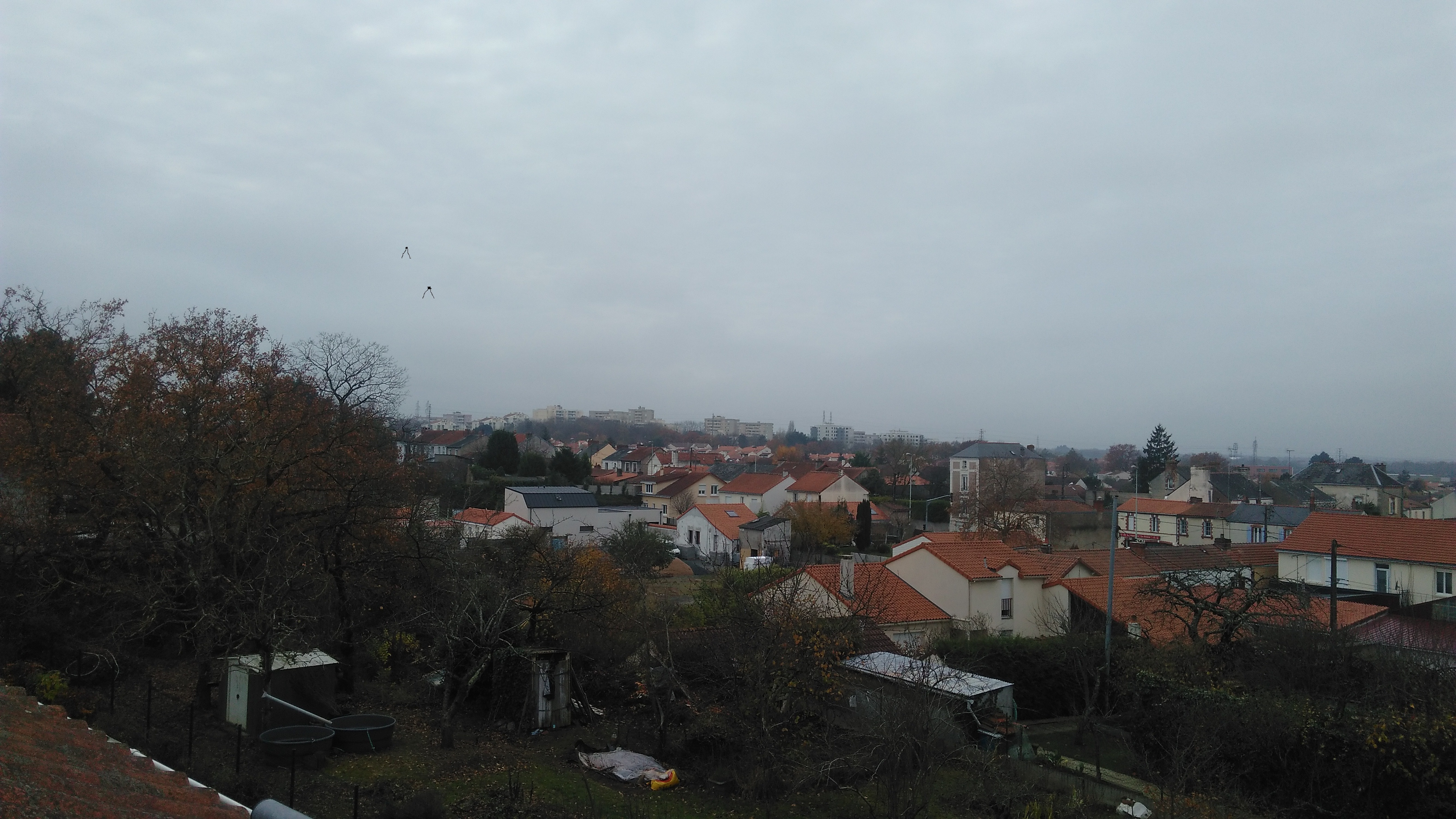
Case description
GEIPAN has completed the assessment of some investigated cases that had remained awaiting classification. It now publishes a synthesis of the witness and investigative information collected at the time (see the attached document).
At about 17:15, a witness and his son, travelling by car, saw an unusual luminous phenomenon in the sky, “elongated and pointing towards the sky.” The witness stopped and used 8×25 binoculars but saw no additional detail. At home, he searched for the UAP and eventually found 2 stationary triangular objects through 12×50 binoculars, this time dark. Clouds finally hid both UAPs around 18:00. He sent GEIPAN a reconstruction of the sighting. Only 1 witness account was collected.
He appears to describe 2 types of UAP:
1. An unusually shaped luminous phenomenon, elongated and pointing skywards, to the south-west of Cholet, about 20° above the ground and approximately 1° tall.
2. Two objects invisible to the naked eye, apparently stationary relative both to each other and to the many surrounding clouds, triangular and dark. He thought these were nevertheless the same as the first, farther away and differently oriented, meaning no longer facing the Sun.
For the second phase, a photograph reconstructing the scene shows the UAPs as inverted Vs with a dot at their base, slightly offset in elevation and azimuth (see the attached document). The witness described the first as white and “dazzling,” like a streetlight seen in broad daylight, and the later ones as dark. He saw no movement.
Asked about a trail or halo, he said that the triangle’s 2 downward branches resembled aircraft contrails, but that these were usually parallel and that an aircraft eventually moved across the sky even if initially on the horizon. He therefore considered ordinary contrails but rejected them on the basis of his experience.
However, contrails are not always parallel. In a very stable atmosphere with little or no wind and low humidity, they can be very short. Depending on the number of engines, as on a twin-engine jet, their arrangement and the turbulence they generate, the trails can diverge behind the fuselage (see example 4 in the attached document).
The dark colour probably resembles example 15 in the attached document. This is typical of contrails at twilight: the Sun has set a few minutes earlier, but the sky is still light. Depending on the terminator’s position—the imaginary boundary, possibly at ground level, between the sunlit atmosphere and the portion in Earth’s shadow—contrails can range from white to grey or black, through yellow, orange or even red.
The first UAP, seen at 17:15, was also almost certainly a persistent aircraft contrail formed when the aircraft temporarily crossed more humid areas. At high altitude, it was still well illuminated by the Sun, which set at Cholet on 24 November 2016 at 17:18, 3 minutes later. Contrast with the darker surrounding clouds produced the impression of dazzling brightness. One of the later trails might have come from the same aircraft, although this is difficult to demonstrate.
The apparent lack of movement has 2 explanations:
- The first was almost certainly a persistent section of contrail. In weak winds aloft, it could remain in approximately the same place for quite a long time.
- For the later UAPs, 2 factors apply. The aircraft were probably very distant and high: the witness said the UAPs were invisible to the naked eye and relatively low on the horizon. Their apparent movement would therefore be slow and could be imperceptible, at least briefly in a clear sky; the sky here was not clear. The witness described many rapidly moving clouds, hence relatively low ones. Their movement prevented him from noticing the aircrafts’ and contrails’ slow movement, and they also repeatedly obscured them.
The one potentially contradictory element, at least for the later UAPs, is the witness’s reported continuous observation “between 17:30 and 18:00.” Even far away and low on the horizon, aircraft would be difficult to observe for so long without eventually noticing their movement.
At 17:30, the Sun was 1°36′ below the horizon at azimuth 241°, to the south-west, as were the UAPs, as checked on the witness’s photograph. Contrails very far from the witness in the same direction as the Sun should logically still have been illuminated and white or orange, rather than dark, if indeed seen from 17:30. For them to appear dark, they must no longer have been sunlit, particularly since they shared the Sun’s azimuth.
The investigation therefore concludes that compatibility with the hypothesis requires the last 2 UAPs to have first been observed well after 17:30. A shorter sighting would fit the hypothesis better. This is an investigative inference; the witness’s stated 17:30–18:00 interval remains as reported.
GEIPAN classifies the case B: misidentification of aircraft condensation trails.
Recorded details
- Local time
- 17:15
- Coordinate precision
- Source-provided or normalized location; precision not increased beyond source.
- Date precision
- day