UFO case file · UFO-42440
FABREGUES (34) 02.09.2019
FABREGUES (34), Languedoc Roussillon, France
Open this case in the interactive Atlas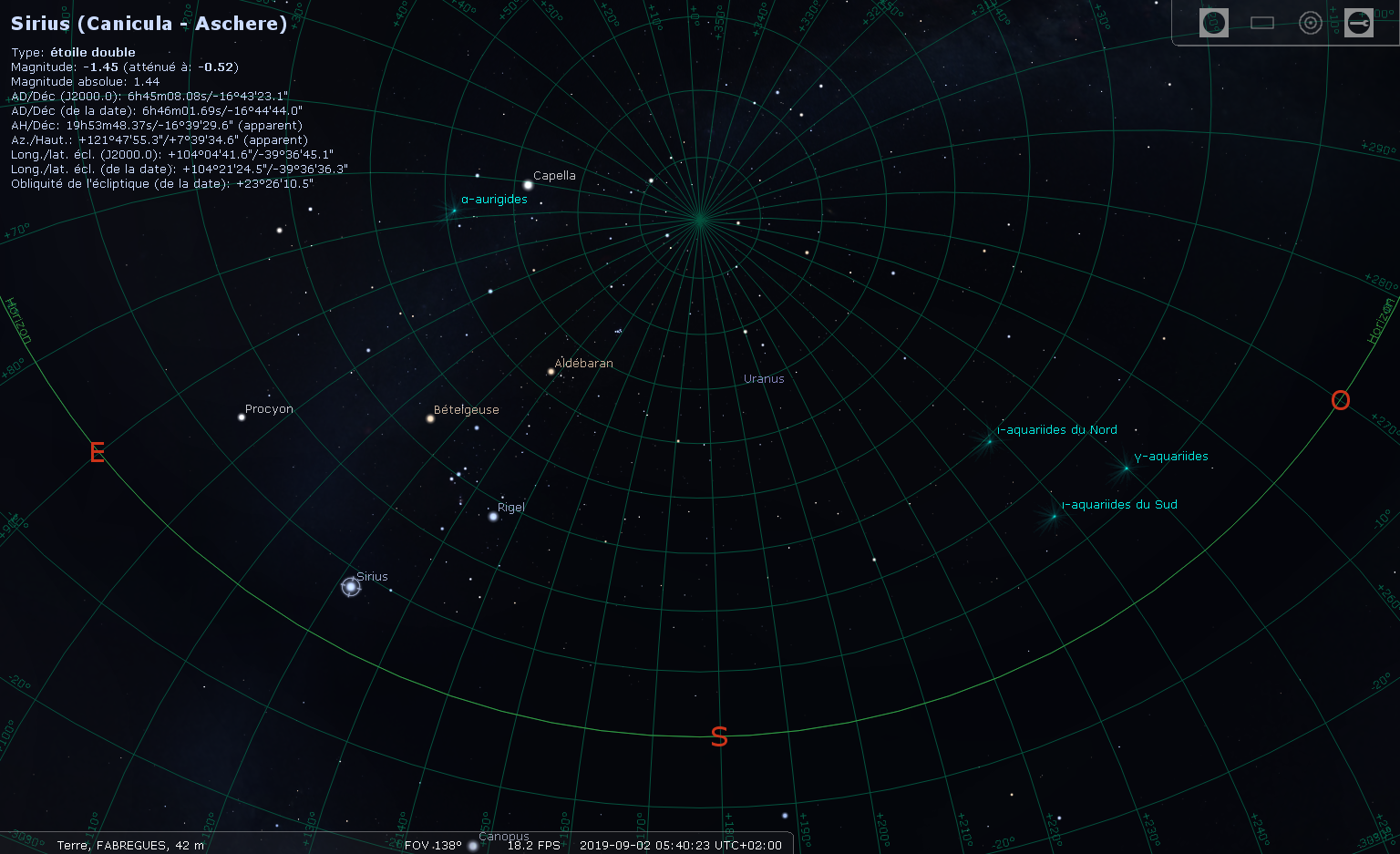
Case description
On Monday 2 September 2019 at about 05:40, a witness on his south-facing terrace saw a twinkling point of light to the southeast in a clear sky. Through binoculars it looked like a disc with three distinct white and colored points of scintillation. It gradually rose and disappeared completely at 06:07. Intrigued, he searched again toward the southeast at 05:00 on Tuesday and Wednesday but saw nothing. On Thursday at 05:29 he saw it again, woke his wife, and she confirmed its presence. Photographs and videos were taken. The point gradually rose and disappeared completely at 07:15. Only one account was collected.
Stellarium confirms that Sirius was visible southeast of the site on 2 September and subsequent days, initially very low and rising toward about 10° between 05:00 and 06:00 (see attached sky chart).
The analysis describes the first and last observations as occurring at 05:30, differing slightly from the introductory 05:40 and 05:29 times. The witness's magnified photographs show the point left of a streetlamp and above the roofs. He thought it was Venus, but it was Sirius.
On 3 and 4 September he looked earlier, at 05:00, when Stellarium shows Sirius lower. The photographs and daytime plan show houses immediately below its observed position, blocking it until it rose sufficiently. Looking half an hour earlier therefore explains why he did not see it on those days.
The magnified videos also confirm the point left of the streetlamp and its proximity to the obstructing roofs.
The unusual binocular appearance—a disc with three white, orange and greenish/bluish points of scintillation, apparently changing orientation—is attributed to optical effects of magnification or the witness's own eyesight. He wrote: 'I must also tell you that I have astigmatism, uncorrected because I do not wear my glasses at breakfast, and it sometimes plays tricks on my perception of objects' shapes.'
Residual strangeness is consequently very low, and the Sirius match is demonstrated. The account has very good evidential strength: precise times, two sighting photographs, two daytime site photographs, three sighting videos and two witnesses, although the spouses completed only one questionnaire together.
GEIPAN classifies the case A: misidentification of Sirius.
Recorded details
- Local time
- 05:40
- Coordinate precision
- Source-provided or normalized location; precision not increased beyond source.
- Date precision
- day