UFO case file · UFO-42517
PLOUHINEC (56) 12.12.2020
PLOUHINEC (56), Bretagne, France
Open this case in the interactive Atlas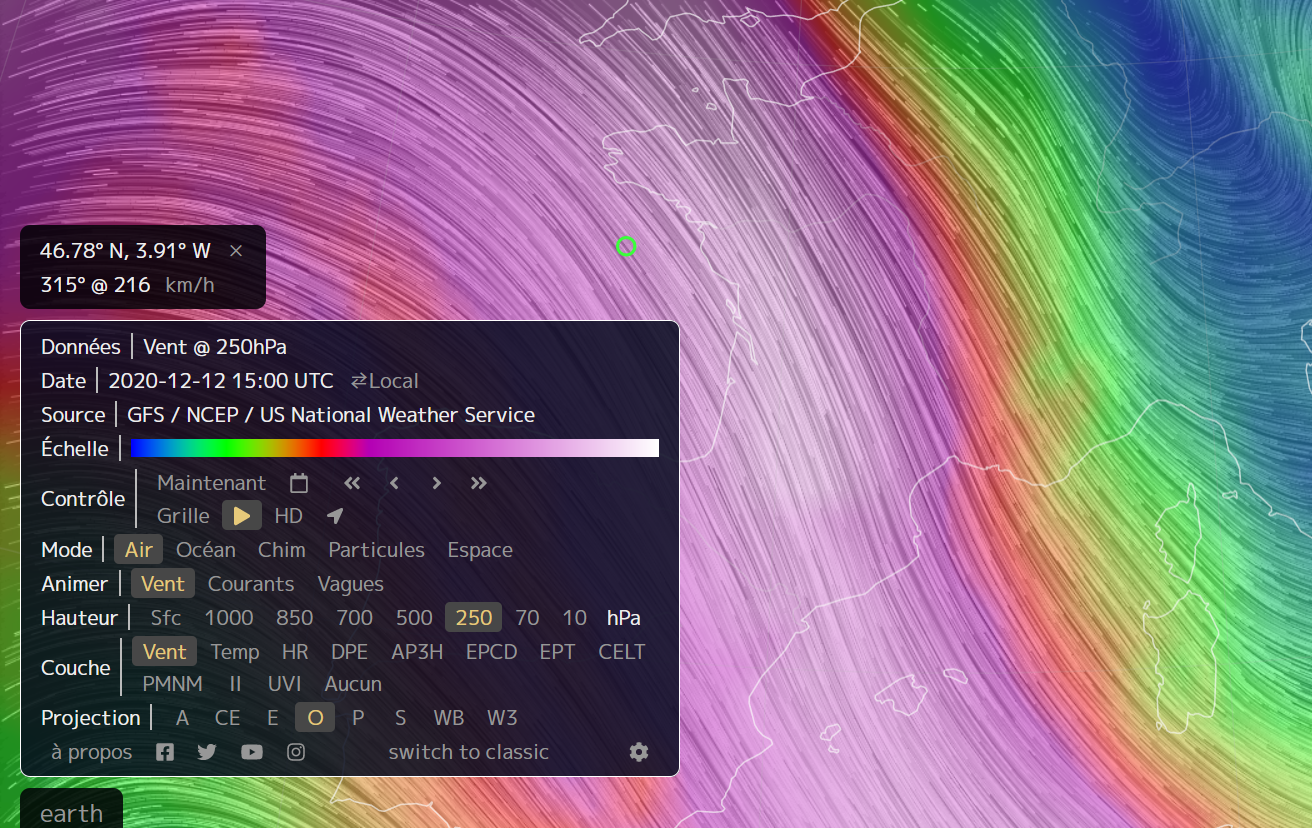
Case description
On 12 December 2020, initially timed at 17:27 local, a witness noticed a strange-looking sky trail, described in the summary as a “large plume of smoke or vapour” with a corkscrew effect, towards the south-south-west. He quickly fetched his camera and photographed what appeared to be an object rushing towards the ocean. He wondered whether it was human-made space debris, a small meteorite entering the atmosphere or something associated with the SpaceShipTwo spaceplane prototype.
He said his camera remained on summer time, correcting the time to 15:27 UTC or 16:27 winter local time. To check the clock, he was asked to photograph the speaking-clock time. This showed that the camera was 15 minutes fast. Assuming its error remained constant between December 2020 and April 2021, the sighting can be timed at 15:12 UTC.
The witness gave bearing 225° and elevation 20°. Analysis of the images with Google Maps and Géoportail gave approximately 220° (see the document). At 16:12 local, the Sun was at azimuth 222° and elevation 8°, inside the photograph’s horizontal field. Since it is invisible, GEIPAN supposes it was behind the thick cloud layer above the horizon. Weather sites confirm very cloudy conditions, 6/8 oktas.
The photographed shape and colour suggest an aircraft contrail. Flightradar24 identifies a candidate Airbus A321, flight TP1359 from London to Lisbon, at 35,000 ft at 15:12, about 150 km away towards the south/south-west (see the document).
The photographs show left-to-right motion, requiring the trail to lie south of the observing position. The candidate aircraft’s path, however, passes to the north. Winds aloft at its inferred location were 216 km/h, oriented at 315°. GEIPAN argues that this could displace the trail several kilometres, from north to south relative to the witness.
The elongated shape in the early photographs fits a contrail, and enlargement even suggests a twin-engine jet. Its azimuth near the Sun’s favours strong reflected light. GEIPAN notes that contrails can be spectacular in certain weather and astronomical conditions, prompting speculation. Very humid air aloft encourages persistence, spreading and irregular dispersal with upper winds (see the contrail article).
GEIPAN classifies the case A: misidentification of an aircraft condensation trail.
Recorded details
- Local time
- 16:12
- Coordinate precision
- Source-provided or normalized location; precision not increased beyond source.
- Date precision
- day