UFO case file · UFO-42600
MOYE (74) 28.02.2022
MOYE (74), Rhône-Alpes, France
Open this case in the interactive Atlas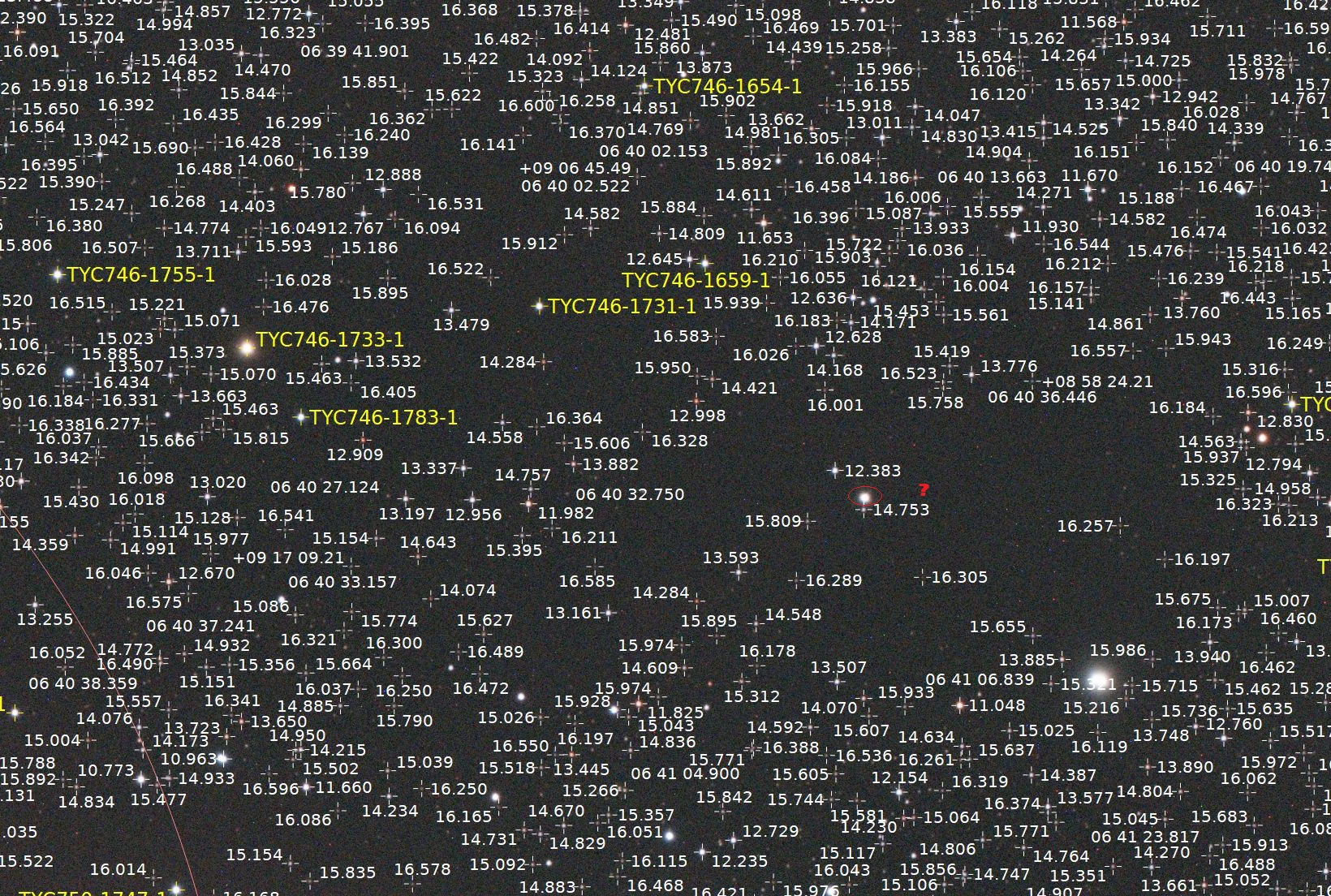
Case description
While sorting photographs taken over 4 days, an amateur astronomer and astrophotographer noticed a bright white star-like point in just 1 image out of a set of 170. He precisely determined its celestial coordinates and the photograph's capture time, then searched several technical databases and sky catalogs to identify it. He also contacted specialist groups including Webastro and the Hoys Citizen Science Project, as well as the astronomy societies of France and Touraine, without obtaining a satisfactory answer.
The case is very well substantiated because the submitted photograph locates the phenomenon precisely. However, the event's time is uncertain within the 5-minute exposure: it occurred sometime during those 5 minutes and cannot readily be timed more precisely. The UAP was not seen with the naked eye, only through a refracting telescope fitted with a dedicated camera.
The exposure was long enough for many faint satellites to pass above the witness. GEIPAN consulted CNES's space-surveillance service, the Centre d'Orbitographie Opérationnelle.
GEIPAN normally handles only direct naked-eye sightings, but nevertheless investigated after receiving the questionnaire and material: the information and photographs suggested a fairly familiar UAP phenomenon, sunlight reflecting from a satellite, and the data were remarkably precise and detailed.
Given the event's brevity, 2 initial hypotheses were considered: a satellite flash or possibly an astronomical gamma-ray burst, specifically the visible component of its signal. The source considers the analyzed observation too short for the latter explanation, which was quickly abandoned.
GEIPAN proposed submitting the “video,” as the source calls it here despite otherwise discussing a photograph, to its astronomy expert. No astronomical phenomenon was cataloged that evening at the viewing time and direction.
Photo analysis revealed a faint trail apparently coinciding with the UAP (see attachments).
For the satellite-flash hypothesis, GEIPAN first searched its database with the dedicated “astronautical environment” tool for a satellite matching the UAP. With no result, it consulted CNES's space-surveillance service. An initial Starlink candidate had outdated orbital elements and was not confirmed after its actual trajectory was analyzed.
Searching for other candidates within the exposure interval found another satellite, but it was in shadow, unlit by the Sun, and therefore could not be visible from the observation site.
Finally, searching at much higher altitude indicated a very probable reflection of sunlight from a DELTA rocket second stage. Reconstruction of the trail visible in the photograph confirmed this hypothesis.
At 20:22:10 UTC, the object was orbiting at an altitude of 6,780 km and lay 0.5° from the estimated viewing direction for that time. The discrepancy is attributable to uncertainty about the flash's exact time within the 300-second exposure.
The case is classified A: a satellite flash, specifically sunlight reflected from a DELTA rocket component.
The case was resolved through collaboration involving expertise supplied to GEIPAN by the Institut de Recherche en Astrophysique et Planétologie (IRAP) and CNES's space-surveillance service, the Centre d'Orbitographie Opérationnelle. The study notably exposed an updating problem in public applications concerning predicted versus actual orbits of newly launched satellites.
Recorded details
- Local time
- 21:21
- Coordinate precision
- Source-provided or normalized location; precision not increased beyond source.
- Date precision
- day