UFO case file · UFO-42736
MANS (LE) (72) 24.03.2024
MANS (LE) (72), Pays de la Loire, France
Open this case in the interactive Atlas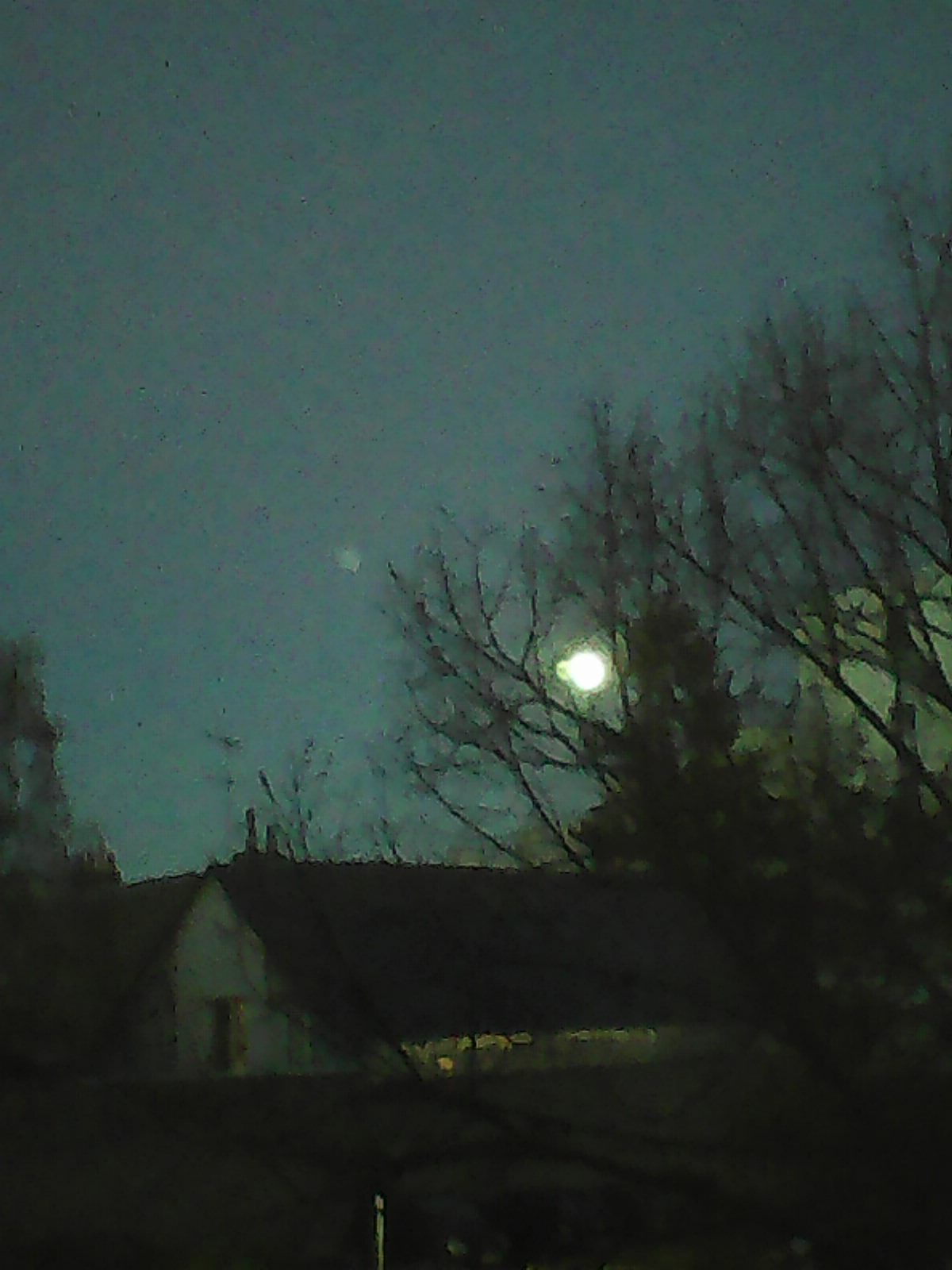
Case description
On the evening of 24 March 2024, a witness in the living room of his apartment in Le Mans (72) saw the full Moon and noticed a golden-yellow spherical UAP beside it. He took a photograph through the open window with his phone and noticed the presence of the UAP on the screen, then took a second photograph later, thinking that the UAP had disappeared. When reviewing the photographs, he found it in the second image too, almost overlapping the lunar disc.
The witness did not observe the movement of the UAP, but inferred it from its successive positions on the photographs (see investigation report).
Substantiation* is moderate: there is a single witness, but an on-site investigation and cognitive interview were conducted, and 2 photographs could be analyzed despite their lack of metadata.
Nevertheless, IPACO* analysis of the 2 photographs (see the investigation report annex) made it possible to:
- Determine the capture time, 19:43 to the nearest minute, from the timestamps of files saved on the phone; this old model generated no image metadata.
- Establish that, despite appearances, the UAP could not be a simple lens reflection.
- Show that its circular appearance was probably an artifact and that it was instead point-like or nearly so.
- Estimate the angular distance apparently travelled by the UAP, which is about 1.5°.
- Using a Google map, specify the initial azimuth and the final azimuth of observation, i.e. 99° and 100.5° respectively.
The on-site investigation on 13 June 2024 demonstrated that there had been a reversal in the witness’s memory of the order in which the photographs were taken, which establishes an apparent movement from left to right as seen by the witness. It also established a precise chronology. The witness probably initially intended to photograph the Moon without seeing the UAP, then saw it while taking the second photograph and lost sight of it immediately afterward behind trees.
Two hypotheses were evaluated: an aircraft landing light and an LED balloon.
- It was not possible to determine the presence of an aircraft in the observation axis at the time of the observation, either by the CAPCODA* radar reconstructions (unusable because of a timing problem) or private flight-reconstruction websites.
- For the LED balloon hypothesis, the wind direction data did not match the observed movement expected of a windborne object. However, some margin of error must be allowed: wind was measured at or very near ground level. The reported azimuths may also vary slightly with the time.
The field investigation also confirmed that the witness did not directly observe the UAP moving or disappearing. Its appearance in the photographs is misleading because of the zoom and the phone’s image-sensor performance.
GEIPAN therefore classified the case C: a phenomenon unidentified for lack of data.
SUBSTANTIATION: Under GEIPAN criteria, the amount of information considered reliable and objectively established that is collected for an account.
IPACO: GEIPAN image analysis and processing software (IPACO.fr).
CAPCODA: Air Operations and Air Defense Planning and Control Center (French Air and Space Force).
Recorded details
- Local time
- 18:45
- Coordinate precision
- Source-provided or normalized location; precision not increased beyond source.
- Date precision
- day