Case description
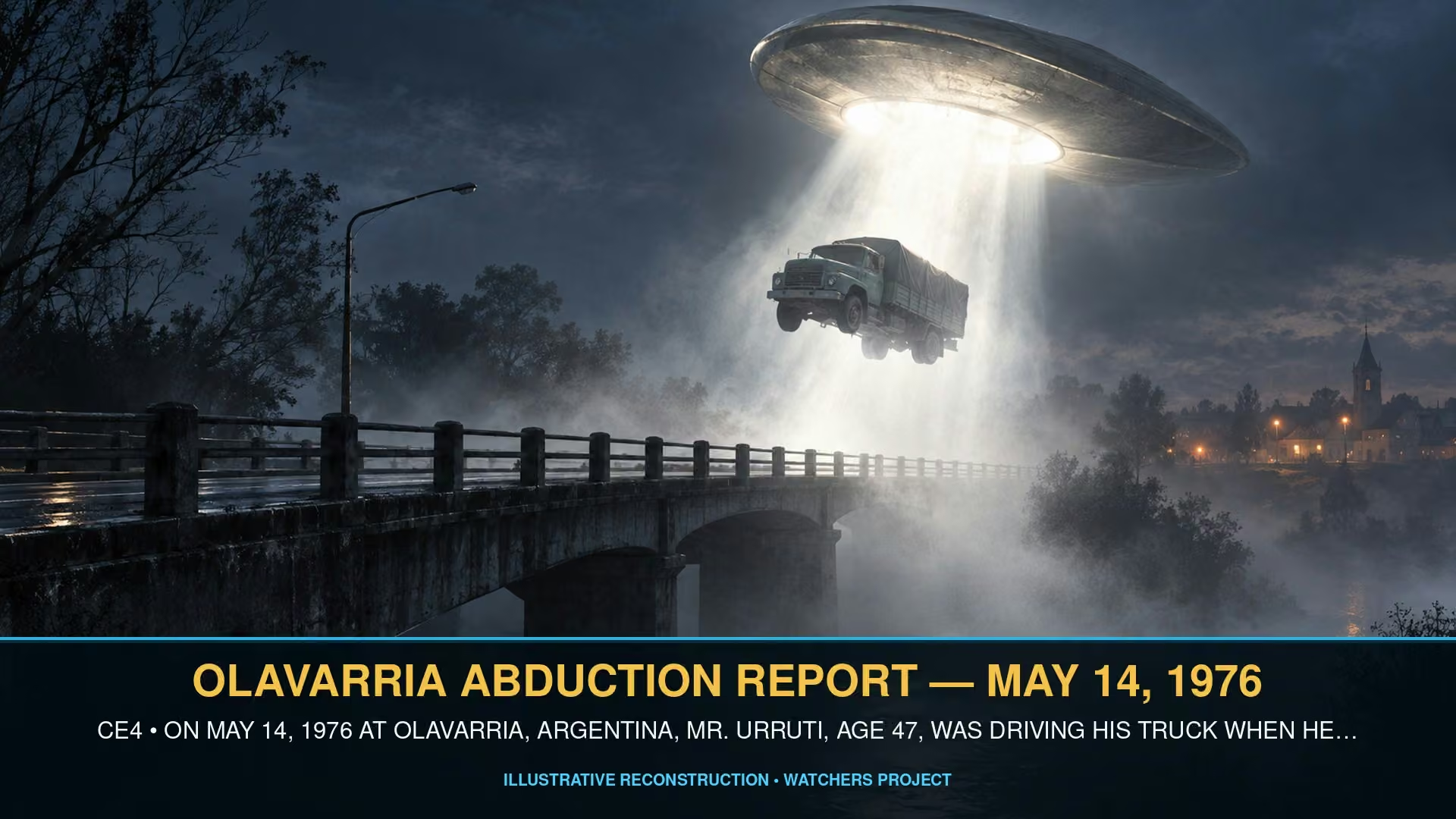
At about 6:20 a.m. on May 14, 1976, Néstor Urruti, forty-seven, was driving a truck from Olavarría toward Bolívar to deliver a tractor. He worked for the Fiat Mariano Acosta dealership and had only recently set out when he reached the bridge near Avenida Pringles. Fog surrounded the crossing. He reported that the streetlights and his truck’s lights went out, followed by an intensely bright yellow and violet light.
Urruti compared the object above him to a huge oyster opening. He said that both he and the truck were taken inside. For a time he could see nothing through the brilliance, then became aware of a horseshoe-shaped panel several metres across. Its instruments resembled clocks without numbers. Other markings looked like flowers, triangles and seahorses.
He did not report seeing any person or living occupant. Nevertheless, he heard a reassuring voice and felt a helmet fitted with cables being placed on his head. The voice told him to remain calm. He later said that some of what he had heard was information he would not disclose because of concern for his wife and daughter.
In investigator Fabio Zerpa’s account, Urruti also described a surrounding screen through which he saw water, plants and seahorses. He subsequently suggested searching the Caribbean Sea for the objects. These were elements of his reported onboard impressions and later statements.
His next remembered situation was back at his workplace, approximately forty-five minutes later, without knowing how he had returned. Distressed and disoriented, he was taken home and then to hospital, where he remained for several days. Later accounts describe medical examinations and questioning during that stay.
The story appeared in La Razón on May 22, 1976, and entered Flying Saucer Review, vehicle-interference catalogues and Zerpa’s investigations. In later interviews Urruti continued to describe contact and information that he felt unable to reveal.